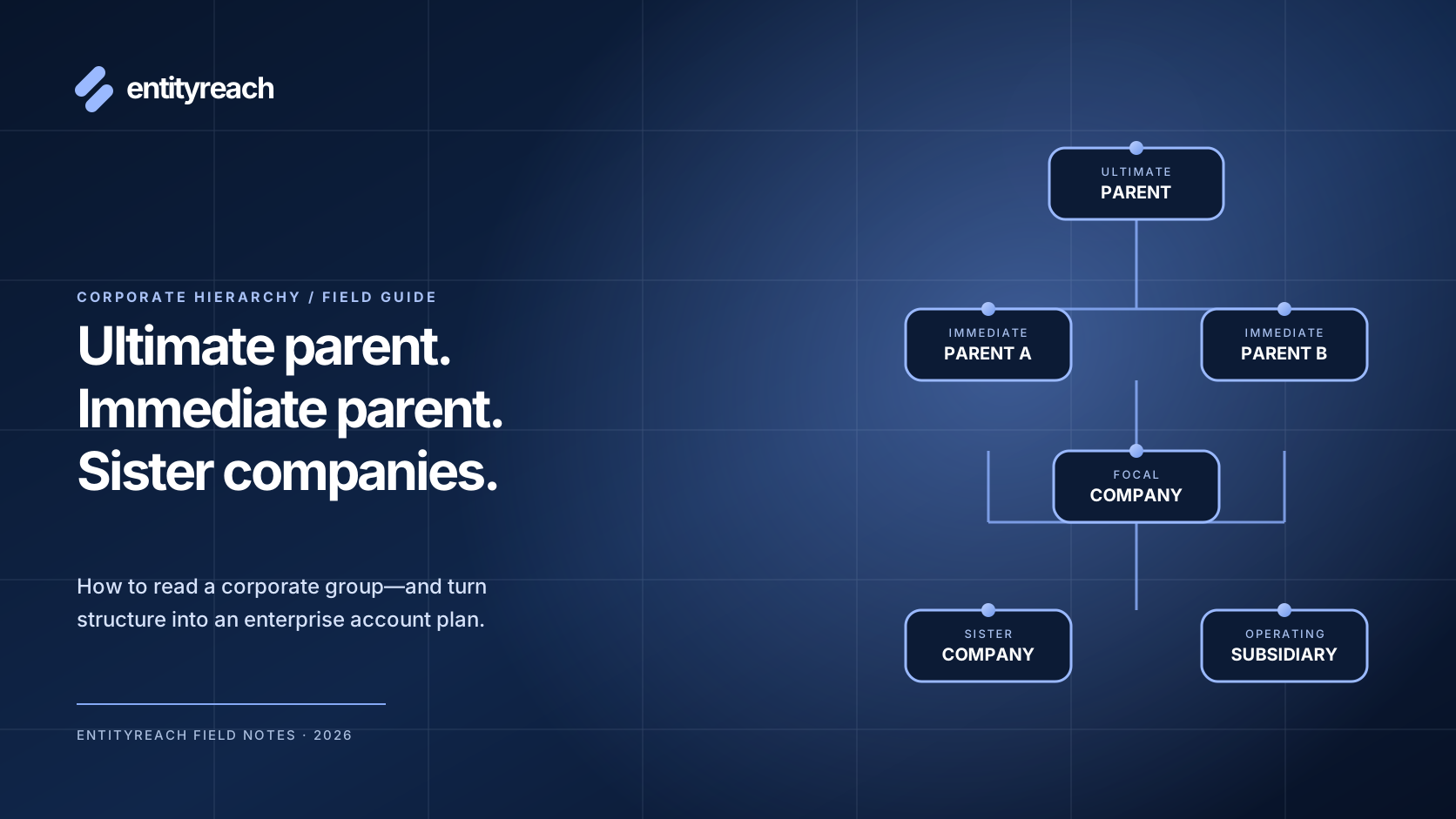
The short answer: an immediate parent directly owns or controls the company you are examining. An ultimate parent sits at the top of the ownership chain. Sister companies share a parent. For enterprise account planning, none of these relationships is automatically the “right” one; the correct relationship depends on whether you are defining account ownership, contract scope, buying authority or an introduction path.
That distinction is easy to miss because most sales systems present a company as one record with one name, one domain and one account owner. Large businesses do not operate that way. A familiar brand may sit above dozens of legal entities, below a regional holding company, or beside other businesses controlled by the same group. The entity on the contract may not be the entity that sets policy, owns the budget or appears in the CRM.
The practical goal is not to build the largest possible family tree. It is to identify the exact legal entity, understand how control runs through the group, and use the relevant relationships to make a better commercial decision. That means preserving the difference between legal ownership, operating influence, contract coverage and human relationships instead of collapsing them into a single “parent account” field.
Ultimate parent, immediate parent, subsidiary and sister company
An immediate parent company is the entity directly above another company in an ownership chain. If North Region Holdings owns the focal operating company, North Region Holdings is its immediate parent. There may still be several entities above it.
An ultimate parent company is the highest entity in the chain that is not itself controlled by another corporate entity under the definition being used. It is the group-level anchor. The ultimate parent may be a listed corporation, a privately held company, a state-owned enterprise or another legal form. Identifying it tells you where the corporate family ends, but it does not prove that all purchasing or operations are centralised there.
A subsidiary sits below a parent in the hierarchy. A direct subsidiary is owned or controlled directly; an indirect subsidiary is reached through one or more intermediate companies. The exact control test can vary by jurisdiction and use case, so an ownership percentage should not be treated as the only possible signal of control.
A sister company is another entity that shares a parent with the focal company. Two companies can be sisters under an immediate parent, under an ultimate parent, or both. For sales teams, this is often the most commercially interesting relationship because it reveals peer entities that may have similar operating problems but are not yet represented in the customer record.
The same company can have several valid parent relationships
Where is group strategy set?
Who controls this entity directly?
Which legal entity do we serve?
Where could a lateral introduction work?
The chart is intentionally simple. Real structures often include multiple intermediate holdings, joint ventures, investment vehicles and companies with ownership divided among several parties. The crucial discipline is to keep each edge explicit. A line should say what the relationship is, which entity sits on each side, what evidence supports it and when that evidence was observed.
A corporate hierarchy maps legal entities. An organisational chart maps people and reporting lines. A relationship map shows who can influence or introduce whom. Enterprise account planning needs all three, but they answer different questions.
Which parent relationship matters for enterprise sales?
The ultimate parent is the best anchor when leadership wants a global view of exposure, revenue or white space across an entire group. It helps answer questions such as: How much do we sell across this corporate family? Which regions remain untouched? Are several sales teams pursuing companies controlled by the same group? Should this be governed as one strategic account?
The immediate parent is often more useful for operational questions. It may own the focal company directly, coordinate a regional cluster, hold the relevant contract or supervise a portfolio of similar businesses. If procurement, technology standards or leadership are organised at that level, jumping straight to the ultimate parent can make the account plan less accurate rather than more accurate.
Sister companies matter when the growth thesis is lateral. The current customer may be one operating company among several peers. A successful deployment can create credibility, but ownership alone does not make the sister company qualified. The sales team still needs to test fit, territory, contract status, decision authority and the legitimacy of any introduction.
Choose the relationship that answers the commercial question
| Account-planning task | Ultimate parent | Immediate parent | Sister company |
|---|---|---|---|
| Define the global account | Primary | Context | Context |
| Check contract coverage | Useful | Primary | Context |
| Find a warm introduction | Context | Useful | Primary |
| Assign CRM ownership | Useful | Primary | Useful |
| Monitor structural change | Primary | Primary | Useful |
Why the highest parent is not always the buying centre
A corporate group can centralise capital allocation while decentralising purchasing. It can share a brand while maintaining separate technology estates. It can negotiate framework agreements centrally but require each subsidiary to approve local adoption. It can also operate the other way around: subsidiaries appear independent, while a group function controls vendor policy.
Therefore, the hierarchy provides a research frame—not an automatic buying model. The account team should treat every structural finding as a hypothesis to validate. Who owns the relevant problem? Who holds the budget? Is the contract local, regional or global? Can the parent mandate adoption? Are data, security and procurement reviews shared? Does the customer sponsor have standing to introduce the team elsewhere in the group?
This is where account expansion strategy and corporate hierarchy research meet. Structure reveals where to look. Commercial qualification decides where to act.
A brand is not a legal entity, and a domain is not a corporate group
Many hierarchy errors begin before ownership research starts. The CRM record may contain a trading name, a product brand or a shortened name shared by several entities. A website may represent an entire group while the contracting party uses a different legal name. One domain may serve multiple subsidiaries; one company may operate several domains.
Begin with entity resolution. Confirm the legal name, registration identifier, jurisdiction and status of the company you actually mean. Where possible, anchor the record to a stable identifier rather than relying on a name string. Names change, transliterations differ and abbreviations collide. Identifiers provide a stronger basis for connecting filings, ownership records and CRM accounts.
Do not accept a hierarchy merely because the names look related. Likewise, do not reject a valid relationship because the names look different. Acquisitions frequently preserve trading brands. Holding companies can have neutral names that reveal nothing about the operating businesses beneath them. Cross-border groups may use local names that do not resemble the global brand.
Control, ownership and affiliation are not interchangeable
A group map should distinguish verified ownership from looser affiliation. Franchisees, distributors, portfolio companies, minority investments and commercial partners may be connected to a brand without belonging to the same controlled corporate family. They can still matter commercially, but they should not be labelled as subsidiaries unless the evidence supports that relationship.
Ownership percentages also need context. A majority stake often signals control, but control can be exercised through voting rights, agreements or other arrangements. Conversely, a large economic interest may not translate into day-to-day operating authority. If the commercial decision depends on control, preserve the underlying evidence and flag ambiguous cases for review.
How to map a company group without creating a data dump
A useful hierarchy starts from a clearly resolved focal company and traces one relationship at a time. Move upward first: identify the direct parent, then repeat until the ultimate parent is reached or the evidence stops. Next, move downward from the relevant parent to find direct and indirect subsidiaries. Finally, move laterally to identify sister companies.
For each entity, keep the legal name, identifier, jurisdiction, status and role in the structure. For each relationship, keep the parent, child, relationship type, confidence level, supporting source and observation date. This turns the result from a picture into an auditable data set.
Then qualify the group for the commercial question. Exclude or separately label dormant companies, special-purpose vehicles and holdings when they are not addressable buyers. Preserve them in the underlying graph because they may explain ownership, but do not let them inflate the sales opportunity. A group with 120 entities may contain only 18 relevant operating companies in the seller’s markets.
A hierarchy becomes useful only when it enters a governed workflow
- 01Resolve
Match the trading name to the legal entity and identifier.
- 02Trace
Follow direct ownership links to the ultimate parent.
- 03Qualify
Separate operating companies from holdings and dormant entities.
- 04Activate
Assign ownership, document the route and choose the next action.
- 05Monitor
Recheck acquisitions, divestitures, renames and dissolutions.
Use depth limits deliberately
More depth is not always more useful. If the goal is a regional expansion plan, the immediate parent and its operating subsidiaries may be sufficient. If the goal is global account governance, the full chain to the ultimate parent is essential. If the account involves regulated onboarding or risk, indirect ownership paths and minority interests may require deeper investigation.
Set the depth according to the decision. This reduces research time, keeps the output explainable and prevents a dense network from hiding the relationships that matter. EntityReach’s company group explorer, subsidiary discovery and parent company lookup are designed around those distinct questions.
One parent field cannot represent a real corporate hierarchy
A single parent-account field is useful for navigation, but it is not enough for enterprise governance. It usually captures only one direct relationship and loses the difference between ultimate parent, immediate parent, regional parent and commercial account owner. Teams then force several meanings into one field, creating inconsistent reporting.
At minimum, retain the focal entity’s stable identifier, direct parent identifier, ultimate parent identifier, relationship type, evidence date and verification status. The CRM can still show a friendly hierarchy, but the underlying model should preserve exact legal relationships. Where the CRM cannot hold the full graph, keep a governed external structure and synchronise the fields needed for segmentation, routing and reporting.
Do not merge sister companies into one account simply because they share a parent. Merging can erase distinct contracts, opportunities, territories and stakeholders. A better model keeps each legal entity as a record, links the records into a hierarchy and creates a group-level view for aggregated reporting.
Separate legal structure from account ownership
Legal ownership and sales ownership follow different rules. A global account director may coordinate the group while local teams own individual subsidiaries. A regional parent may belong to one territory while an operating company belongs to another. The system should express both dimensions rather than rewriting the corporate hierarchy to match sales territories.
Define a conflict rule before expansion begins. Who owns a newly discovered sister company? Does the current account owner receive the opportunity, the local territory owner, or a global account team? When is collaboration required? Without a clear rule, better hierarchy data can create internal disputes faster than it creates revenue.
Entity matching is equally important. Duplicate records, outdated names and records anchored only to web domains can fragment the group view. A controlled matching process should prefer stable identifiers, keep alternative names and route uncertain matches to review. This is the foundation for reliable corporate hierarchy data inside the CRM.
How sister companies become credible expansion candidates
The mistake is to export every sister company and call it pipeline. Structural connection is not commercial qualification. A useful shortlist combines relationship evidence with operating fit and a defensible route to a conversation.
Start with the sister companies closest to the current customer’s operating context. Look for similar activities, comparable scale, shared markets, common technology or a group-wide policy that could make the existing use case relevant. Then check whether they are already covered by a framework agreement, owned by another sales team or previously disqualified.
Next, identify the warm-path hypothesis. The existing sponsor may know a peer, but the team should not assume that a common parent creates permission to use the customer’s name. Ask the sponsor whether the problem exists elsewhere and whether an introduction would be useful. The strongest message is based on a validated common problem, not on the fact that two companies share an owner.
Rank the candidates with transparent reasons. A concise record might say: “Active UK operating entity; sister of current customer under the same regional parent; similar compliance workflow; no existing contract coverage; sponsor can validate ownership of the process.” That is far more useful than a hidden score or an unexplained list.
Corporate structure expands the search space. Evidence, fit and permission reduce it to a credible next move.
Corporate hierarchy data decays when companies change
Acquisitions, divestitures, mergers, dissolutions and renames can alter an account plan without changing the brand seen by the sales team. A newly acquired subsidiary may enter the customer group. A divested business may leave a global agreement. A holding-company reorganisation may change the legal path while operating relationships remain stable.
Monitor the entities and relationships that influence commercial decisions. High-value strategic groups may justify continuous or frequent checks. Lower-priority accounts can follow a periodic review. The cadence should reflect the consequences of stale data, not an arbitrary calendar.
Alerts should explain what changed and why it matters. “Parent changed” is incomplete. A useful alert identifies the old relationship, the new relationship, the effective or observed date, the supporting evidence and the accounts or opportunities affected. It should also trigger a defined review: contract coverage, territory ownership, stakeholder mapping, account tier or opportunity priority.
Do not overwrite history. Keep previous relationships with dates so the team can explain why an account was grouped differently at an earlier point. This is particularly important when revenue attribution, sales compensation or contract rights depend on the structure at a specific time. See corporate group monitoring for the operational workflow.
A corporate hierarchy checklist for enterprise account teams
Before the group map influences territory, pipeline or outreach, test whether it can survive a skeptical review. The goal is not perfect certainty. It is clear evidence, explicit limitations and a decision that can be repeated by another person.
If several boxes remain unchecked, the hierarchy may still be useful for research, but it is not ready to drive automated routing or executive reporting. Keep the decision human-reviewed until the evidence and governance catch up.
Frequently asked questions
What is an ultimate parent company?
An ultimate parent company is the highest company in the relevant control hierarchy, with no company above it under that definition. The exact meaning depends on the data source. For example, GLEIF identifies the ultimate accounting consolidating parent, which should not automatically be treated as the top shareholder or the organisation that approves purchases.
What is an immediate parent company?
An immediate parent company is the company directly above another entity in the ownership or control hierarchy being used. It may itself belong to a larger group. Always check the source's definition: a direct shareholder relationship and a direct accounting consolidating parent describe different concepts and should not be assumed to match in every structure.
What is the difference between an immediate parent and an ultimate parent?
The immediate parent is the next company above an entity; the ultimate parent is the highest company in the defined hierarchy. If Group A controls Holding B, which directly controls Trading C, B is C's immediate parent and A is its ultimate parent. Keep both relationships so intermediate entities remain visible in your account structure.
Can the immediate parent and ultimate parent be the same company?
Yes. If the company directly controlling a subsidiary has no higher corporate parent under the definition you are using, it is both the immediate and ultimate parent. This is common in simple two-level structures. Record both fields consistently rather than assuming an ultimate parent must always sit several layers above the subsidiary.
What is a sister company?
A sister company is another company under the same parent or common corporate control. The term describes the relationship between the companies, rather than one owning the other. Because people sometimes use it broadly for companies in the same group, a corporate map should show the actual parent links instead of relying on the label alone.
Is a sister company a subsidiary?
A company can be both. It is a subsidiary in relation to a parent that controls it and a sister company in relation to another company under the same parent. For example, if Parent A controls Companies B and C, B and C are A's subsidiaries and are sister companies to each other.
How do sister companies work together?
Sister companies may share services, leadership, technology or purchasing arrangements, but the extent varies across groups. They can also serve different markets and make independent commercial decisions. For sales planning, confirm how collaboration works in practice and which legal entity will buy, use and pay for your solution before treating the group as one account.
How do you identify a company's ultimate parent?
Start with the company's exact legal name and registration identifier, then follow parent relationships through current filings, annual reports and reliable corporate data. Where available, LEI records add accounting consolidation relationships. Check the definition, effective date and supporting evidence at each step; a matching brand name, website or address does not establish ownership.
Do companies with the same ultimate parent have the same immediate parent?
No. A group can contain several intermediate holding companies, each with its own subsidiaries. Two businesses may therefore share an ultimate parent while having different immediate parents. Keeping the full chain helps you distinguish a close sibling relationship from a more distant connection elsewhere in the group and plan the appropriate sales approach.
Does an ultimate parent control purchasing for every subsidiary?
An ultimate parent relationship does not tell you who makes a particular purchasing decision. Some groups centralise procurement, while others give subsidiaries or divisions substantial autonomy. Verify the budget owner, approval process, contracting entity and scope of any group agreement before assuming that a parent relationship gives access to every business in the group.
Does a missing parent record mean a company is independent?
No. Missing information can reflect incomplete coverage or a reporting exception. In LEI data, reasons can include a parent without an LEI, nonpublic information or the absence of an accounting consolidating parent. Preserve the distinction between a verified independent company and an unknown relationship, and investigate the stated reason before classifying the account.
How often should you update parent and sister-company relationships?
Review relationships before major account-planning, territory or contracting decisions, and whenever an acquisition, disposal or restructuring is announced. Keep the evidence source, relationship date and last verification date with each record. Announced transactions and completed changes are different events, so update the hierarchy when the relevant change actually takes effect.
Use the smallest hierarchy that answers the question
Use the ultimate parent when you need a group-wide view. Use the immediate parent when you need the direct control relationship. Use sister companies when you are testing lateral expansion. Use the full ownership path when governance, risk or auditability requires it.
Above all, keep structure separate from assumptions about buying behaviour. The fact that companies belong to the same group is meaningful evidence, but it is not proof that they share budgets, systems, decision makers or supplier contracts. A strong account plan shows the relationship, states what is known, identifies what remains unconfirmed and turns the largest uncertainty into the next question.
That is how a corporate family tree becomes commercially useful: not as a static diagram, but as an evidence-led map of where to investigate, who needs to validate the opportunity and what changed since the last decision.