Your CRM can have complete fields, standardised names and no obvious duplicates—and still give the sales team the wrong picture of a customer. The problem is often not missing contact data. It is that the system cannot reliably distinguish one legal entity from another.
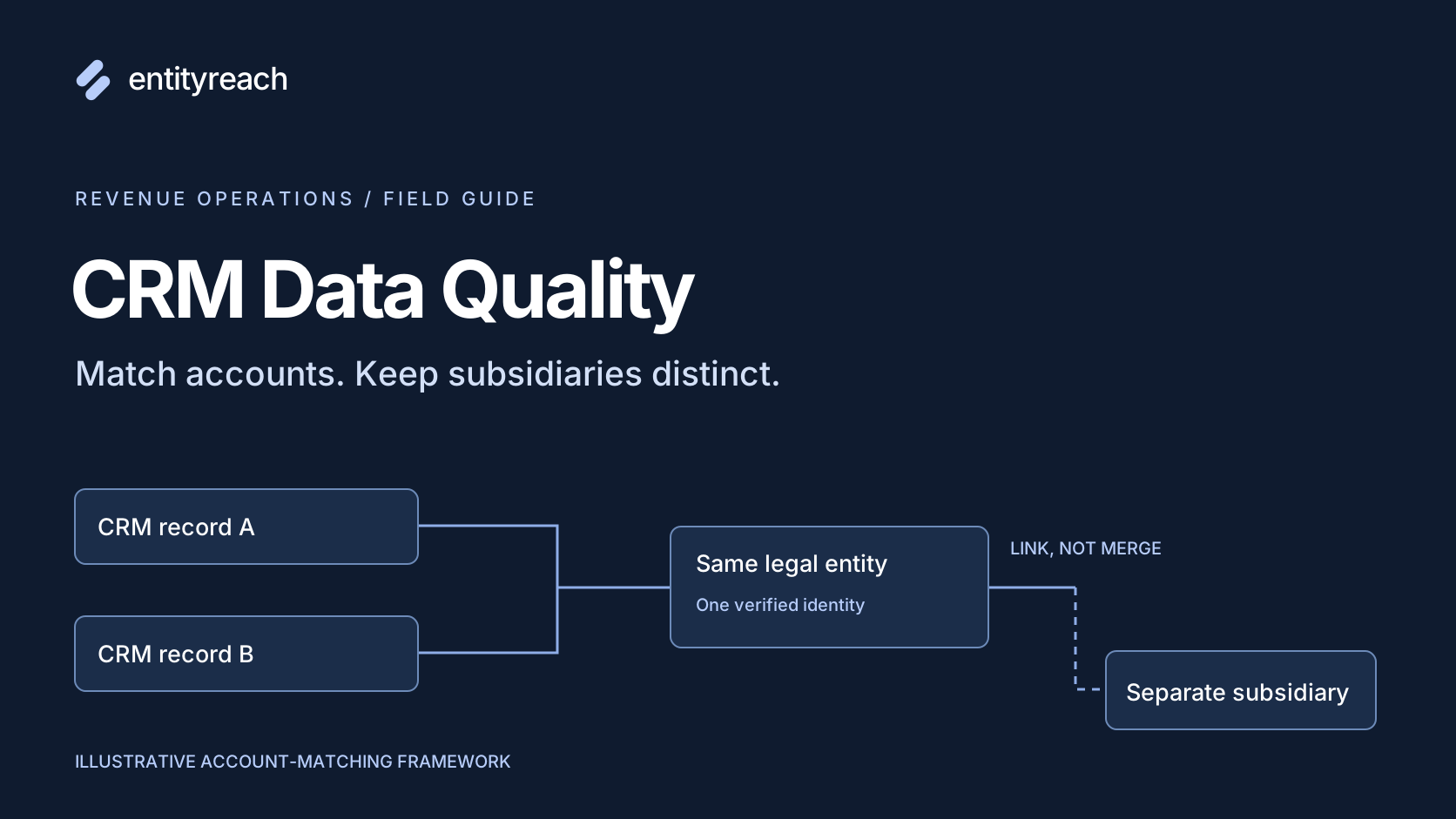
Consider two account records using the same group website. One represents the company that signed your agreement. The other represents a subsidiary in a different country. Merge them because their domains match and you may hide a genuine expansion candidate. Keep two records for the same contracting entity without connecting them and you may count the same opportunity twice.
CRM data quality for enterprise sales therefore needs a stricter definition: can the data support the particular decision you are about to make? This guide focuses on account identity, matching and commercial coverage. It complements the broader account expansion strategy without repeating the process for ranking subsidiaries or mapping buying stakeholders.
Start by deciding what an account record represents
A CRM account might represent a registered company, a branch, a brand, a buying organisation or a global commercial relationship. All can be useful. Problems arise when the same object carries these meanings without an explicit record type. A headquarters address is then treated as the address of every subsidiary, or a global account director is mistaken for the owner of every local opportunity.
Write a short definition for each account type before changing records. The legal-entity record should identify a specific registered organisation. A location record should identify an operating site where needed. A commercial group record can coordinate selling across several entities, but it should not replace the entities that sign agreements or hold opportunities.
Keep two questions separate. Entity matching asks whether records describe the same organisation. Corporate-family matching asks whether different organisations are related. A valid family relationship is often a reason to link two records, not merge them. Likewise, distinct names do not rule out either a duplicate or an ownership connection.
Can we prove these records represent the same thing—and preserve their contracts, opportunities and history if we consolidate them?
This boundary becomes more important when automated workflows use account data. A wrong relationship can influence several downstream decisions: who owns the record, whether a company receives outreach, which customers appear in a segment, and how revenue rolls up. Adding automation before defining the record model only distributes an unresolved assumption faster.
How to audit CRM data quality for strategic accounts
Begin with a bounded population, such as the entities attached to your largest customer groups. Include active customers, open opportunities and unmatched company records from the same groups. Document the selection rule. A sample containing only easy, domestic matches will not reveal the problems faced by a team selling across jurisdictions and acquired brands.
For each record, inspect the legal name, registration identifier and issuing jurisdiction together. A registration number without its scope may be ambiguous. Check whether the value is a legal identifier, a tax identifier or an internal account code. Preserve leading zeros and distinguish a missing identifier from an identifier that failed validation.
Next, examine repeated domains, similar names, different spellings and recently renamed businesses. These are review candidates, not automatic errors. Check parent links, the date behind each link, and whether contract coverage was inferred from ownership. Include a small deliberate set of difficult cases: separate subsidiaries on one domain, unrelated companies with similar names, and entities that have changed group.
Record the outcome as accepted, review, hold or unresolved. Accepted means the current evidence supports the match under your policy. Review means a person must decide. Hold means conflicting evidence prevents activation. Unresolved means there is not enough information. These categories make gaps visible without encouraging the team to force every record into a match.
Report unresolved records, not just successful matches
Audit a sample of accepted records against independent evidence as well. The rate at which a system returns an answer is not the rate at which its answers are correct. To investigate missed matches, review unmatched records and selected rejected candidates. Report the sample size and selection method alongside any accuracy estimate; do not generalise a convenient sample to every country or account type.
Account matching, deduplication and hierarchy linking need different rules
A practical matching process has three stages. First generate plausible candidate entities. Then evaluate the evidence for each candidate. Finally choose a CRM action. Keeping these stages separate lets a broad candidate search improve discovery without lowering the standard for an irreversible merge or a consequential account update.
An exact, correctly scoped registration identifier is stronger evidence than a similar company name, but it still needs context. Check for placeholder values, copying errors and records deliberately created for different locations of one entity. Where reliable identifiers are absent, combine name, jurisdiction, address, website and other relevant evidence. Do not let a shared address or domain decide the match on its own.
There is no universal confidence threshold that makes all account updates safe. A score is useful only when its meaning has been evaluated on representative examples. The acceptable uncertainty for suggesting a research candidate can be different from the uncertainty allowed before moving a live opportunity or changing an account owner.
Match identity before choosing the CRM action
| Evidence | Interpretation | Next action |
|---|---|---|
| Same scoped registration identifier; evidence agrees | Same entity candidate | Review duplicate consolidation |
| Shared domain; distinct legal identifiers | Different entities | Keep separate; investigate group link |
| Similar name; different jurisdictions | Ambiguous identity | Review; do not auto-merge |
| Verified common parent; different entities | Related companies | Link for group reporting |
| Conflicting legal identifiers | Identity conflict | Hold update; resolve evidence |
For a confirmed duplicate, define which record survives and what happens to related contacts, activities, opportunities and integrations. Retain a mapping from the old record identifier to the surviving record. Review the effect in a test environment before applying the change to important accounts. A technically successful merge can still be commercially wrong if it removes context sellers need.
For distinct companies with verified common ownership, keep separate records and add the appropriate relationship. Use the immediate and ultimate parent guide when deciding which hierarchy field answers the business question. Never rewrite the legal hierarchy merely to make it resemble the sales territory model.
Store enough evidence to explain every important field
The minimum useful company record contains the CRM identifier, legal entity identifier and its scheme, jurisdiction, legal name, known aliases and entity status. Add the match decision, matching method, evidence location, source observation date and last review date. These fields make it possible to distinguish a deliberate decision from an accidental import.
Store relationships separately from identity. A parent link should identify both entities, describe the relationship, state the definition used, and include the supporting evidence and relevant dates. Keep legal ownership separate from the commercial group used for account management. If your CRM cannot represent every relationship, synchronise the fields needed for daily work from a governed external model.
Define field-level update rules. An enrichment feed might propose a legal name change, while your contract system remains the source for agreement coverage. A seller may know the correct operational contact without being authorised to change a corporate parent. The latest arriving value should not automatically override better-supported information.
For conflicts, preserve the old value, the proposed value and their evidence. Differences may reflect distinct dates or definitions rather than a bad provider. Route consequential disagreements to a named reviewer, keep the decision reversible, and record why the chosen value was accepted. This is more useful than a generic “data verified” flag with no explanation.
Do not turn missing information into account white space
Once entities are matched, compare them with contracts and active deployments. Use three states at minimum: verified covered, verified not covered and coverage unknown. A company absent from one CRM report may already be served under another entity name or group agreement. Absence is a question to investigate, not proof that the company is an available prospect.
Define the coverage denominator explicitly. It might be commercially relevant operating entities in agreed territories, not every legal vehicle in the group. Record excluded holdings or out-of-scope businesses with reasons. Otherwise a reorganisation that adds several holding companies can make account penetration appear to fall even though customer adoption has not changed.
Unknown coverage is not confirmed white space
The example separates customer coverage from knowledge coverage. Four of ten relevant entities are confirmed covered. Seven of ten have a known coverage state. The remaining three require investigation. Even the three verified uncovered entities are not pipeline: a seller still needs to establish a problem, buying process and credible next step.
Maintain opportunity-level checks as well. Two subsidiaries can participate in one buying initiative, and one entity can hold several distinct opportunities. Count the commercial transaction according to your forecasting rules rather than creating an opportunity for every linked company. Correct identity provides a reliable base; it does not decide how revenue should be recognised or when a buyer will sign.
Monitor company changes without silently rewriting the past
An acquisition announcement, a completed ownership change and an updated registry record are different events. Store the dates available to you and avoid implying that the date of your import is the date the business changed. If completion is unconfirmed, create a research task rather than immediately moving every affected subsidiary into a new group.
When a parent changes, identify the dependent decisions. The account owner may need review. Contract coverage may need confirmation. A global reporting view may need a new current hierarchy. None of these actions follows automatically from the ownership link alone. A divested company may retain a transitional commercial arrangement that the hierarchy data cannot establish.
Keep previous relationships and their validity or observation periods so an earlier account plan remains explainable. Decide whether each report shows the current group or the group as it was at the reporting date. Mixing those approaches can change historical comparisons without any change in the underlying transactions.
Use corporate group monitoring to organise the research workflow, but assign the business review internally. Every important alert needs a destination, owner and decision. An inbox full of structural changes does not improve CRM data quality unless someone resolves their effect on the account.
Run a controlled rollout before expanding automation
Start with one sales segment or a limited set of strategic groups. Capture the baseline: unresolved entities, reviewed match errors, missing relationship evidence and time spent resolving each case. Measure these on a consistent population so changes in scope do not masquerade as improvements in quality.
In the first pass, produce proposed updates without changing production records. Have revenue operations review identity rules, account teams validate commercial context, and the relevant contract owner confirm coverage. Keep a rejected proposal log. It reveals where matching logic, source interpretation or the account model needs adjustment.
Apply approved changes in a bounded batch, check downstream reporting and routing, and retain a rollback path. Before the next batch, review incorrect accepted matches as well as missed matches. Different countries, entity types and naming conventions may need different handling; do not assume success on one group proves readiness for the entire CRM.
When evaluating a data provider or matching tool, use the same difficult examples for each candidate. Ask for evidence behind returned identifiers, explanation of parent definitions, treatment of unresolved records and the ability to preserve history. Compare correction effort and decision usefulness, not just returned-row counts or headline database size.
Every activated record has an explainable identity decision. Every unresolved case has an owner. Every consequential change can be traced and reversed.
The objective is not a cosmetically clean CRM. It is a system in which sellers can tell which company they serve, which related companies remain unqualified, and which facts still need checking. Corporate hierarchy data helps connect the entities. Disciplined account matching keeps those connections from erasing the differences that matter.
Frequently asked questions
How do you audit CRM data quality?
Start with a defined set of accounts and the decisions they support. Check legal identifiers, duplicate records, parent links, contract coverage and evidence dates. Review both accepted matches and unmatched records against independent evidence. Report errors by type and business consequence, then assign an owner and correction deadline to each material issue.
How do you improve CRM data quality?
Fix the rules that create bad records, not only the existing rows. Require the appropriate entity identifier, separate legal relationships from sales ownership, and review uncertain matches before changes reach production. Add field-level source and date information, retain previous values, and check important accounts again before routing, renewal or expansion decisions.
What CRM data quality checks matter for corporate accounts?
Check whether each account represents a legal entity, a location or a commercial grouping. Validate identifier and jurisdiction combinations, look for separate entities sharing a domain, and confirm parent relationships independently. Then test contract coverage and reporting roll-ups. A populated field is not necessarily accurate, and an empty parent field does not establish independence.
What is the difference between account matching and deduplication?
Account matching connects a CRM record to the company it represents. Deduplication identifies multiple records representing the same thing and determines whether consolidation is appropriate. Two records can match different subsidiaries within one group without being duplicates. Establish identity first; only then decide whether to merge records, link them or retain them separately.
Should subsidiaries with the same website be merged in the CRM?
No, a shared website alone is not sufficient evidence for a merge. Several legal entities may use one group domain while holding separate contracts, opportunities and responsibilities. Keep their identifiers and records distinct, connect them through verified relationships, and use a group reporting view when you need consolidated visibility across the customer family.
How does B2B data enrichment improve CRM quality?
Enrichment can add legal names, identifiers, locations and corporate relationships that make account records more useful. It improves quality only when the incoming information is matched to the correct entity and checked against existing evidence. Define which source may update each field, preserve conflicting values for review, and avoid replacing verified customer information with an unexplained guess.
How do you measure CRM data quality?
Measure several dimensions separately: identifier completeness, confirmed match accuracy, unresolved records, duplicate rate and relationship freshness. State the population and review method for every percentage. For account matching, sample rejected or unmatched records as well as accepted ones; otherwise, you may see incorrect matches but miss genuine accounts that the process failed to connect.
How can better CRM data quality improve forecasting?
Correct entity and opportunity links help prevent double counting and clarify which company is expected to buy. Separate existing contract coverage from genuinely incremental scope, and retain the reporting hierarchy used for each forecast period. Better records make the forecast more interpretable, but they cannot establish buyer intent, budget or a close date without commercial evidence.
Can AI agents safely update CRM company records?
They can assist within controlled rules. Let them propose candidate matches, identify conflicts and explain the evidence, while limiting automatic updates to approved cases. Keep an audit trail and a way to reverse changes. Ambiguous identity, subsidiary merges and changes affecting contracts or territory ownership should receive appropriate human review before activation.
Who should own CRM data quality in an enterprise sales team?
Revenue operations should coordinate the rules, metrics and correction workflow, with named owners for specific decisions. Account teams validate commercial context; a data steward reviews identity and hierarchy conflicts; contract owners confirm agreement coverage. Assigning everything to sellers usually leaves cross-account errors unresolved because no individual seller controls the entire corporate group.
How often should account matching and hierarchy data be checked?
Set the cadence according to decision risk and source availability. Review important records before renewal, territory allocation or expansion activity, and when material company changes are detected. Track the source observation date separately from the last import date. A freshly imported record may still describe an older ownership relationship that needs confirmation.
What should happen when company data sources disagree?
Keep the conflicting values and their evidence rather than silently choosing the latest import. Check whether the sources describe different dates, jurisdictions or relationship definitions. Route material conflicts to a reviewer and mark the decision as unresolved until the evidence is sufficient. Do not let uncertain parent links automatically change account ownership or contract coverage.