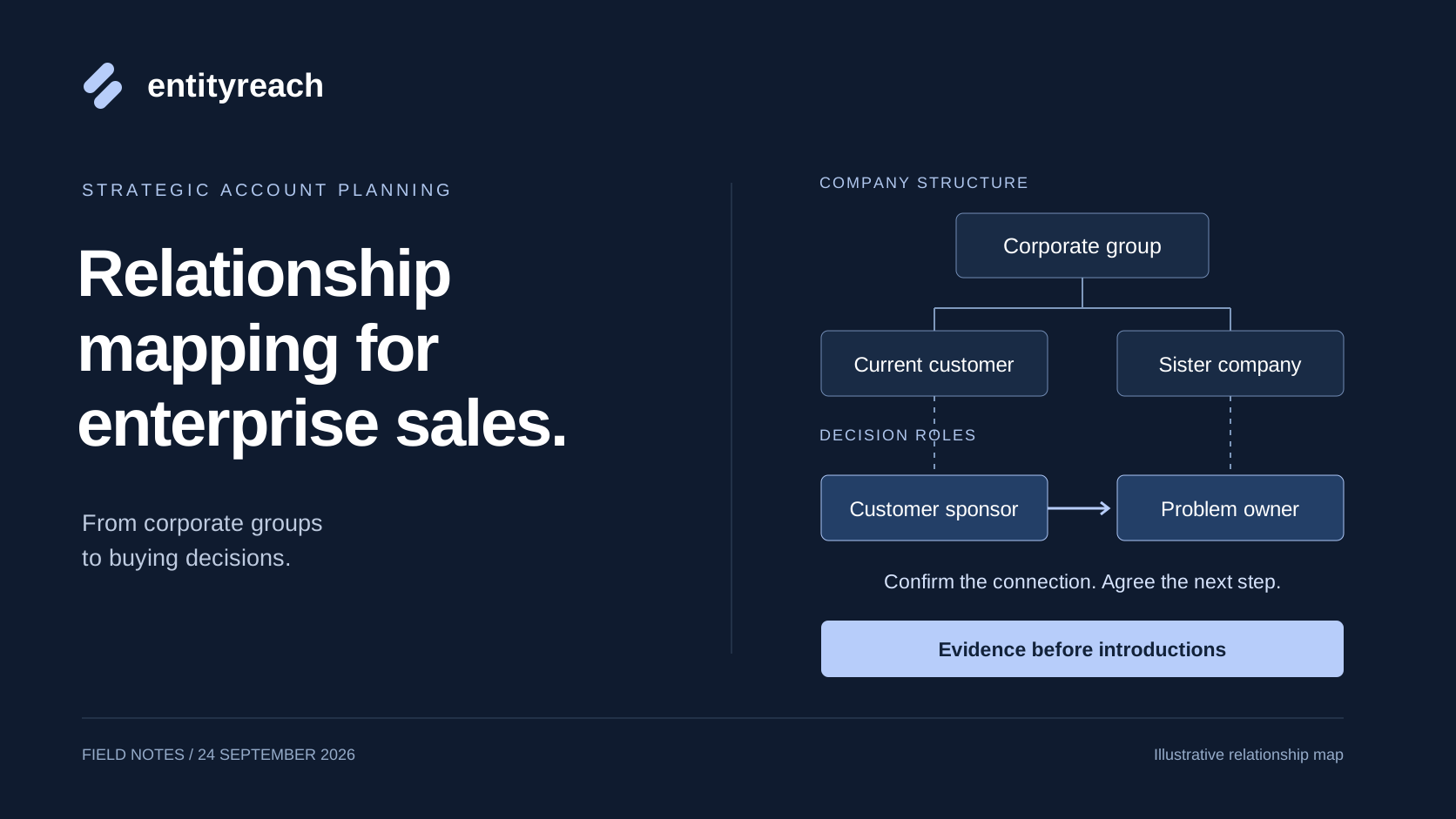
Relationship mapping connects a buying decision to the people who influence it and the evidence behind your access to them. In enterprise sales, that map must also show which company each person represents. Knowing a customer’s procurement director does not establish a route into every subsidiary.
A corporate group can contain attractive expansion candidates while offering very few credible introductions. Equally, an account team may know several senior people but have no contact with the function that owns the problem. A useful map exposes both situations before the team commits seller time or makes promises about a global rollout.
This guide focuses on the handoff between company research and a real buying conversation. Use the account expansion strategy guide to select and prioritise related entities. Then use relationship mapping to establish whether there is a defensible path into the particular decision you want to advance.
Account mapping, organisation charts and relationship mapping
The terms overlap in sales practice. Account mapping can mean identifying stakeholders, comparing partner account lists or examining a corporate family. Agree on a working definition before combining outputs from several tools. Otherwise two teams can say they have mapped an account while describing entirely different work.
For this workflow, the company map identifies legal entities, ownership links and the commercial scope under consideration. The organisation chart describes reporting relationships and formal responsibilities. The relationship map records relevant connections, influence and access paths around a specific purchase. Each view needs its own evidence; none can safely stand in for the others.
For example, a German subsidiary may share a parent with your UK customer. That is a company connection. Its operations director may report to a regional executive. That is an organisational relationship. Your customer sponsor may work with that director on a joint project and be willing to introduce you. That is a potential commercial path, which still needs confirmation.
Current buying-group products, including Demandbase’s offering, put more emphasis on identifying roles and gaps inside an account. This makes the boundary between the maps especially useful: a proposed buying group answers a different question from a verified corporate family. Combining them should make the evidence more explicit, rather than make every connection look equally certain.
Start with one buying decision, not every available contact
Choose a concrete expansion hypothesis. For example, a group already uses your supplier-data service in one country and may need a comparable process in another. Specify the intended workflow, participating entity, expected business outcome and reason to investigate now. If those points are unclear, more names will not resolve the commercial uncertainty.
List the decisions that would be necessary for the purchase to proceed. Someone must confirm the operational problem. Someone must establish the budget path. Technical, security or data teams may need to validate the solution. Procurement must explain the buying process. A local owner may have to approve adoption even when a group team negotiates terms.
These are responsibilities, not a fixed list of job titles. One person can perform several roles, and one responsibility can be shared across people or entities. A group CTO may set architecture standards without owning the local budget. A procurement contact may manage vendor onboarding without deciding whether the business needs your product.
Record the question attached to each role. For an operational owner: which process is failing, and what would an acceptable improvement look like? For a technical evaluator: what must be demonstrated? For procurement: what route and timing are realistic? This keeps the map tied to decisions rather than seniority.
Verify authority across subsidiaries before extending a relationship
Group responsibilities can be narrower than a title suggests. A global function might advise local teams, operate a shared service, approve a standard or hold purchasing authority. Those arrangements produce different sales paths. Ask which entities, products and decision stages are within a stakeholder’s remit instead of recording a single “global decision maker” label.
Keep the employer and the scope of responsibility as separate fields. A person employed by a holding company may coordinate work across operating subsidiaries. Another person may carry a group title while owning one regional programme. Attach evidence to the scope, including the date and the person who confirmed it.
Contract coverage is another separate question. Your current agreement may or may not permit use by a related entity, and an eligible affiliate may still require a local purchase decision. Confirm scope with the appropriate contract owner. Do not infer an entitlement, endorsement or budget commitment from the ownership tree.
If the entity boundary is uncertain, resolve it before adding people. The guide to immediate parents, ultimate parents and sister companies explains the corporate relationships. The CRM account-matching guide addresses records that describe the same company or different related companies. Those checks prevent a good contact from being attached to the wrong account.
A relationship mapping template the account team can maintain
Start with a small table before designing a complex visual. Each row should connect a person, a role and a defined opportunity or entity. Store the internal relationship owner so colleagues know whom to consult. The relationship owner is the person who can explain the connection, not necessarily the CRM account owner or the most senior employee.
| Field | What to record |
|---|---|
| Decision and entity | The proposed purchase, legal entity identifier and any confirmed group scope. |
| Person and role | Who is involved, what they decide and whether that responsibility is confirmed. |
| Relationship owner | The colleague who knows the person and can validate the proposed approach. |
| Evidence and date | The relevant conversation or record, its scope and when it was last confirmed. |
| Next question | The uncertainty to resolve, accountable owner and agreed review date. |
Separate facts from interpretations. “Attended a meeting about the German rollout” is an observation. “Controls the German budget” is a claim that needs specific support. Likewise, an enthusiastic discussion does not establish internal sponsorship. Record what the person has agreed to do, such as introduce a colleague or review a proposal, rather than assigning support from tone alone.
Use clear status values: confirmed, inferred and unknown for role evidence; not requested, requested, agreed and completed for an introduction. These are different dimensions. A stakeholder can have a confirmed role while your introduction request remains unapproved. A completed introduction can lead to someone whose authority is still unclear.
Keep sensitive discussion details in the appropriate restricted record. The shared map generally needs a concise business summary and a pointer to evidence available to authorised colleagues. Avoid copying entire email threads or personal observations into a broadly visible account plan. Good collaboration does not require every user to see every underlying communication.
Measure confirmed buying-role coverage instead of contact volume
A long contact list can create a false sense of readiness. Define the relevant decision roles first, then count how many have been confirmed. If four operating companies each need five role assignments investigated, the denominator is twenty assignments. It is not twenty unique people, because one person may cover several roles.
A filled contact list can hide unconfirmed buying roles
ConfirmedInferredUnknown
In this example, nine assignments have been confirmed. Six have plausible candidates and five have no identified person. Reporting fifteen roles as “mapped” would combine verified knowledge with hypotheses. Reporting nine as confirmed preserves the uncertainty and gives the next account review a practical agenda.
Do not use the percentage as a universal release threshold. One unconfirmed responsibility can matter more than several completed rows. Missing the person who controls security approval may block an evaluation; missing an optional adviser may not. Show critical gaps by decision stage alongside the count, and explain why a gap can or cannot wait.
Also distinguish role coverage from access and support. You may know who holds the budget without being able to reach them. You may have met the approver without securing agreement on the problem. Track these differences separately so the chart cannot be mistaken for pipeline probability or customer commitment.
What happens if your main sponsor leaves?
A map with several contacts can still depend on one introduction route. Ask which conversations would remain possible if your principal sponsor changed role, became unavailable or stopped supporting the project. This is a stress test of access, not a prediction about the individual.
What remains if your main introduction route disappears?
The illustrative comparison starts both maps at nine accessible role assignments. Removing one route leaves three in the concentrated map and seven in the more distributed map. The practical question is which important responsibilities become unreachable, not which chart looks stronger. Losing the only path to one decisive approver may outweigh several surviving connections.
Build additional relationships through the work itself. Invite the relevant technical owner to a technical discussion, ask the operational sponsor who will use the output, and agree when procurement should participate. Adding people without a reason can undermine the sponsor’s trust and increase the customer’s coordination burden.
Document objections as well as supporters. A stakeholder who questions data quality, implementation cost or business impact is identifying a condition the deal must satisfy. Mark the specific issue and the evidence needed to resolve it. Labelling someone a blocker without context makes the map less useful to colleagues inheriting the account.
Turn a relationship into a useful next step
Before requesting an introduction, make the relevance easy to assess. Identify the entity and function, explain the proposed problem in one sentence, and state what you want to learn. The sponsor should be able to decide whether the request makes sense without reading a full sales brief.
Give every connection a decision to support
Company connection
A verified sister companyIs this entity relevant to the proposed use case?
Decision role
Local operational ownerWho owns the problem and can confirm its priority?
Relationship evidence
A current sponsor knows that ownerHas the sponsor confirmed the connection and its scope?
Agreed next step
A specific introduction requestWhat useful question will the first conversation resolve?
A useful request might ask whether the local supplier-onboarding team faces the same entity-matching issue the current customer has already discussed with you. The desired next step is a short validation conversation, not an implied group-wide purchase. Give the sponsor room to correct the hypothesis or suggest a different owner.
Agree what can be shared. A successful deployment can support credibility when the customer permits that use, but confidential results, pricing or internal problems should not travel automatically with the introduction. Record permission for using the sponsor’s name and the limited context of the request.
If the introduction is declined, preserve the reason. Timing, relevance, relationship sensitivity and lack of authority lead to different next actions. Do not treat every refusal as a need for more persistent outreach. Sometimes the correct outcome is to pause the candidate or return to the company-level qualification.
What relationship mapping tools and AI should help you do
Relationship mapping software should make the account team’s reasoning easier to inspect. Evaluate whether it can distinguish people from entities, preserve responsibility across multiple subsidiaries, attach evidence to a link and show when a claim was last confirmed. Ask what happens when a person changes employer or an entity leaves the group.
Use one realistic account during a demonstration. Include two companies sharing a domain, a group function with limited authority and a sponsor whose influence is local. Ask the tool to represent the uncertainties without forcing a false parent, role or introduction. Check that exports and CRM updates preserve those distinctions.
AI can suggest roles, organise permitted activity and identify missing information. Require the system to distinguish retrieved facts from inferred connections. A plausible title match is a research lead, not proof of buying responsibility. An email exchange establishes communication, not support, and a mutual connection does not establish willingness to introduce.
Measure the operational benefit against the same work done before implementation: time to validate a role, reviewer corrections, unresolved scope questions and completion of agreed next actions. A larger graph is not by itself an improvement. The useful result is a clearer decision with less avoidable research and fewer unsupported assumptions.
Use the map in the account review
For each active expansion candidate, review the buying decision, the critical role gaps and the next question. Ask which new evidence changed the plan since the previous review. Give every unresolved point an owner and a date. If nothing changes across several meetings, investigate whether the opportunity has enough relevance or customer engagement to justify continued effort.
Update the map when someone changes role, a responsibility is clarified or a relevant company relationship changes. Corporate group monitoring can support the company side of that review. The account team must still validate what a structural change means for existing contacts, contract coverage and the buying process.
Keep a short decision history. A map should explain why a team pursued one subsidiary, paused another or chose a particular introduction route. That history helps a new account owner distinguish an old assumption from a current fact and prevents the same unresolved questions from being rediscovered every quarter.
Can the team explain which company it wants to reach, which decision it wants to advance, who matters to that decision and what evidence supports the next step?
Frequently asked questions
What is relationship mapping in enterprise sales?
Relationship mapping records who participates in a buying decision, how those people are connected to your team, and what evidence supports each connection. For enterprise expansion, attach each person and decision role to the relevant company or group function. The output should expose missing knowledge and identify a credible next action, rather than merely display contacts.
How is account mapping different from relationship mapping?
Teams use account mapping to describe several activities, including partner overlap and stakeholder research. In this guide, the account map defines the companies and commercial scope; the relationship map describes the people and routes into a particular buying decision. Define these terms internally so a corporate ownership link is never mistaken for an introduction or purchasing authority.
How do you create a relationship map for a customer group?
Choose one proposed purchase and confirm which entities it concerns. List the decisions needed, then attach candidate people to those roles with evidence and dates. Separate confirmed facts from hypotheses, identify the colleague who owns each relationship, and agree one next question for each important gap. Validate cross-company responsibilities before extending a local contact across the group.
What should a relationship mapping template include?
Include the opportunity, entity identifier, buying role, person, organisational scope, internal relationship owner, evidence, confirmation date and next action. Track role confirmation separately from introduction status. A useful template also records what the stakeholder needs to decide, unresolved objections and when the information should be checked again. Keep unknown fields explicit rather than filling them with assumptions.
Is a relationship map the same as an organisation chart?
An organisation chart describes formal reporting lines. A relationship map describes connections relevant to a decision, including influence, working relationships and introduction paths that may cross reporting lines. Someone outside the buyer’s department may control a necessary technical review. Conversely, a senior manager in the organisation chart may have no role in the particular purchase.
How do you map relationships across subsidiaries?
Anchor people to their actual employer and record any additional responsibilities as separate, evidenced relationships. Ask whether a group role sets policy, controls budget, approves vendors or merely advises local teams. A parent’s ownership of two subsidiaries does not establish shared purchasing. Keep local decisions visible even when one central stakeholder influences several entities.
How should relationship strength be measured?
Use observable evidence such as a recent relevant conversation, a confirmed role in the decision or an agreed introduction. Email frequency can support a review but cannot establish support or authority on its own. Keep strength, scope, sentiment and recency separate, and ask the person who owns the relationship to confirm whether the proposed action is appropriate.
What should you look for in relationship mapping software?
Test whether the software separates companies, people, buying roles and relationship evidence. It should preserve scope, dates, unknowns and review history while fitting your CRM permissions and account ownership rules. Use a realistic group with shared domains and central functions during evaluation. A polished visual is less useful if it hides why an important link was created.
Can AI build a reliable relationship map?
AI can organise permitted records, suggest likely roles, highlight missing information and summarise evidence. Treat suggested links as hypotheses until validated. A generated map must not turn a public job title into verified buying authority or a mutual connection into an agreed introduction. Require supporting evidence for consequential recommendations and human review before acting on uncertain relationships.
How often should a sales relationship map be updated?
Review it before material deal decisions and whenever a relevant person, responsibility, corporate relationship or buying process changes. An active evaluation may need weekly review; a dormant expansion hypothesis may need less. Assign a review owner and record when important links were last confirmed. Rechecking a narrow set of decisive relationships is more useful than redating the whole map.