Understand how legal companies connect. Review the parent chain, relationship evidence and source context before bringing a related business into your account plan.
Relationship recordExample data · Fictional companies
Relationship path
GBParent companyMeridian Europe
GBExisting customerMeridian UK
DESister companyMeridian Germany
Two companies connected through a shared parent. Commercial fit and purchasing responsibility require a separate account review.
Which company are we talking about?
Legal name
Meridian Germany
Country
Germany
Registration
Confirm against your records
Names and websites help you search. Legal identity anchors the account.
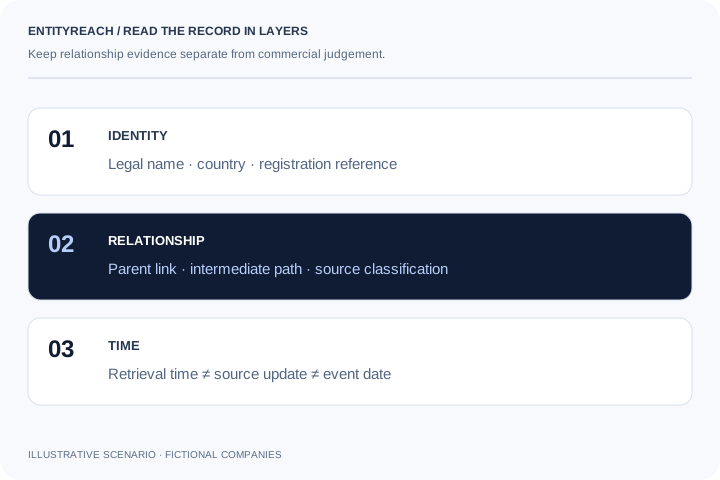
Know what each layer can—and cannot—answer.
Corporate hierarchy data: research evidence and account planning decisions
Data layer
Useful for
Does not establish
Legal name, country, registration
Matching the customer entity and avoiding name confusion.
That two similarly named businesses share ownership.
Parent–subsidiary relationship
Following a returned corporate connection.
Shared procurement, product demand or contract coverage.
Source classification
Understanding how the relationship is described.
Uniform certainty across every field in the record.
Retrieval and source dates
Separating when data was requested from when a source changed.
A transaction date when no transaction date was supplied.
Inspect the layers behind the link.
01
A corporate tree is different from an employee org chart.
EntityReach maps companies and their relationships. It does not map employee reporting lines. The starting company can connect upwards to parents, downwards to subsidiaries and sideways to sister companies.
02
Registry-sourced company facts and relationship modelling are different.
A company profile can contain official registry information while a group relationship is classified as modelled. EntityReach requests the available provenance and displays the classification returned for the relationship. It does not relabel modelled links as registry-confirmed.
03
Identifiers make results usable.
Legal name, country and registration number help you identify a company. A provider profile ID supports further profile retrieval where available. Relationships that lack an internal ID remain visible, with the limits of further lookup explained.
04
Evaluate against the groups you actually sell to.
Coverage should be tested using representative customer accounts and their important countries. A broad company-record count is not a measurement of complete group coverage. Inspect the returned links, source classifications and unresolved entities.
Account context
Read provenance at the field and relationship level.
A registry-sourced company profile and a modelled relationship can appear together. Treat the company identity, the group link and its date as separate evidence. A detailed profile does not make every connection equally complete or equally current.
A usable identity does not guarantee a complete relationship record.
Identity fields present6
Relationship returned5
Source date present3
Illustrative audit of six records. Counts overlap: six have identity fields, five have a returned relationship and three have a source date. This is not a provider coverage statistic.
Identity first. Interpretation second.
01
Resolve identity
Use the legal company, country and registration details as the anchor for the account review.
02
Inspect the link
Read the relationship and source classification. Retain intermediate companies in the path.
03
Record the limit
Carry missing dates, unresolved profiles and relationship uncertainty into the plan rather than hiding them.
Use cases
Apply the evidence to your account plan.
CRM reconciliation
Connect the account to the legal entity.
A trading name or website may not uniquely identify the company you serve. Compare country and registration details before mapping the group.
Next actionRecord the legal identity alongside the internal account name.
Corporate hierarchy data describes how legal companies connect within a group, including parent and subsidiary relationships. In EntityReach it supports company-group research and account expansion, rather than a chart of employee reporting lines.
What is corporate linkage data?
Corporate linkage data connects company records through relationships such as parent and subsidiary. It helps you understand the wider legal group behind a customer, while commercial fit and agreement coverage remain separate questions.
How is corporate hierarchy different from an organisational chart?
A corporate hierarchy connects legal entities. An organisational chart usually describes people, roles or reporting lines inside a business. EntityReach’s group explorer focuses on the company relationships used in account planning.
Which fields help identify the right legal company?
Start with the legal name, country and registration number where available. A trading name or domain can help discover possible matches, but it may represent more than one entity and should be confirmed.
Are all corporate relationships registry verified?
No uniform verification claim should be made. Available records can contain different source classifications, and some relationships may be modelled. Read the returned provenance and preserve the distinction in your account research.
What does a modelled relationship mean for my account plan?
Treat it as a relationship to investigate with its source classification retained. Do not present it as a confirmed registry link or use it alone to infer contract coverage, buying authority or product demand.
Is retrieval time the same as the source update date?
No. Retrieval time records when data was requested. A source update or event date describes a different point in time and may not be supplied. Keep those concepts separate when discussing a change.
Why can a group entity lack a profile ID?
The relationship source can return a company name or registration information without a resolvable detailed profile. EntityReach retains the entity, but deeper profile or contact lookups may be unavailable.
Can corporate hierarchy data verify beneficial ownership?
The account expansion workflow is not a complete beneficial-ownership or compliance determination. Use the returned group evidence for its stated purpose and investigate ownership conclusions through an appropriate verification process.
How should I evaluate corporate hierarchy data quality?
Test known accounts, confirm identities, compare expected relationships and inspect provenance and dates. Record absent, unresolved and conflicting records separately. A successful company match alone does not demonstrate complete group coverage.
Explore your customer’s wider group.
Start with a company you serve. Find where your offer could fit next.
 View full-size diagram