Trace the companies above the customer you serve. Understand immediate and higher-level parent relationships, discover sister companies and ask better questions about group purchasing.
START WITH YOUR CUSTOMERFOLLOW THE RETURNED PATH
Account consideration
Which legal entity is named on the agreement?
Start from the company your team actually serves. A group brand is not a unique legal identity.
Parent company lookup: research evidence and account planning decisions
Relationship concept
How to read it
Account expansion implication
Immediate parent
The entity directly above your starting company.
A useful place to investigate shared services or group agreements.
Highest returned parent
The top entity present in this result.
Wider context, subject to gaps in the returned chain.
Global ultimate parent
A completeness-sensitive conclusion about the full ownership chain.
Do not apply the label solely because an entity is at the top of the screen.
Sister company
Another company connected under a shared parent.
A candidate for a separate fit, coverage and purchasing review.
Use cases
Ownership context for account decisions.
Group procurement
Find the right question for a central buying team.
An intermediate parent may connect regional operations. Treat it as context for a procurement conversation rather than automatic proof of purchasing authority.
Next actionAsk which entities and products fall under the group agreement.
Follow the link. Understand the buying question.
01
Distinguish the direct parent from the top of the tree.
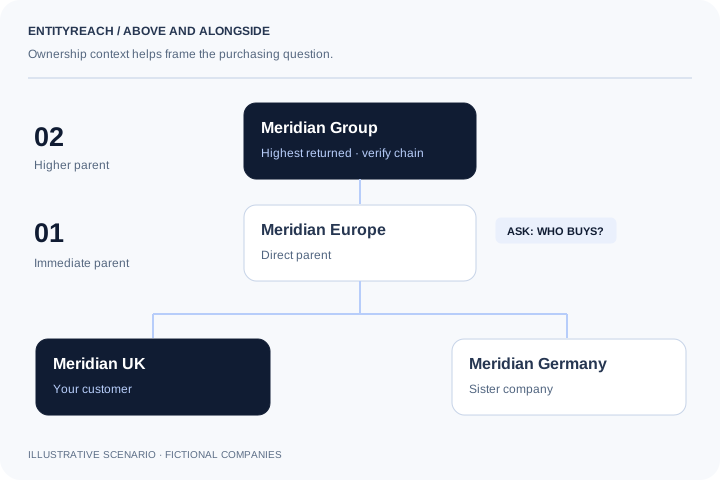
The direct parent sits immediately above the selected company. Further parent entities can connect it to a much wider group. The top entity in a returned tree should not automatically be treated as a confirmed global ultimate parent when coverage is incomplete.
02
Explore sideways, as well as upwards.
Once you understand the parent connection, look for sister companies under the same parent. These may operate in different countries or business lines. Each candidate needs its own fit and purchasing review.
03
Turn the parent relationship into a practical question.
Use the account plan to record what you need to establish: who buys centrally, which companies the existing agreement covers and whether your customer can introduce you. Keep confirmed information separate from assumptions.
Start with your customer. Trace upwards.
01
Start from your agreement
Identify the legal company you actually serve, rather than a familiar trading name or group logo.
02
Trace above and alongside
Inspect the immediate parent, higher entities and available sister-company connections.
03
Ask about purchasing
Confirm which entities are covered, where budgets sit and whether your sponsor can support an introduction.
Account context
Ownership and buying authority are different questions.
A parent relationship helps explain why companies are connected. It does not tell you which team selects software, who holds the budget or whether an agreement extends across the group. Use the chain to investigate buying structure and introduction routes without assuming central control.
One ownership chain can reveal several directions to investigate.
Direct parent · steps1
Higher parent · steps2
Sister company · steps2
Illustrative relationship distances from Meridian UK. One step reaches the direct parent; two reach the highest returned parent or a sister company. Distance is not a confidence or opportunity score.
Search for the legal company, confirm its country and registration details, then open the available parent relationships. Retain the chain between the starting entity and each parent so you can distinguish immediate from higher-level connections.
What is a parent company?
A parent company controls another company. In account research, the relationship provides group context; it does not by itself prove that the parent buys on behalf of every subsidiary or controls every operational decision.
What is the difference between a direct and ultimate parent?
The direct parent is immediately above the company. An ultimate-parent conclusion concerns the top of the full chain. Because returned data can be incomplete, EntityReach distinguishes the highest returned entity from a verified ultimate parent.
Can I look up a parent company by website?
A website can help find possible company matches. Confirm which legal entity the site represents before following its parents, especially when a group uses one domain for several operating companies.
How do I find sister companies?
Trace the shared parent and inspect other companies connected beneath it. Sister companies may operate in different markets and require separate fit and agreement checks before becoming expansion candidates.
Does shared ownership mean shared procurement?
No. Purchasing may be local, regional or centralised. The ownership chain helps you choose who to ask, but the responsible team and agreement scope need confirmation from your commercial research.
What if no parent company is returned?
Treat that as a data outcome, not proof that the company is independent. Check the legal-entity match and available source information, then investigate a familiar reference company or discuss the coverage gap.
Can the highest returned parent be a holding company?
Yes. A holding entity can sit above operating companies. Review its role before treating it as a sales account or assuming it owns the operational buying decision.
Can EntityReach establish beneficial ownership?
The product supports company-group relationship research for account expansion. A returned corporate tree should not be treated as a complete beneficial-ownership determination or a substitute for a dedicated compliance investigation.
How should I use parent company data in account planning?
Keep the relationship path with your customer record, inspect related operating companies and document the question about fit or purchasing. Save the next action and responsible owner label so the research can move into an account review.
Explore your customer’s wider group.
Start with a company you serve. Find where your offer could fit next.
 View full-size diagram