Evaluate company matching, relationship coverage and account relevance on groups you already know. Build an evidence-based view of where EntityReach supports your expansion workflow.
Include familiar groups, relevant territories and the types of company your team actually serves.
02
Capture the evidence
Record the expected entities, returned identities, relationship paths and gaps in the evaluation worksheet.
03
Review with the account owner
Assess new knowledge and useful next actions separately from coverage counts and projected revenue.
Account context
Evaluate useful account decisions, not just the size of a database.
Start with accounts where your team can compare the returned group against known entities and countries. Keep matching success, relationship completeness and commercial relevance separate. A data gap and an out-of-territory business are different reasons for excluding a candidate.
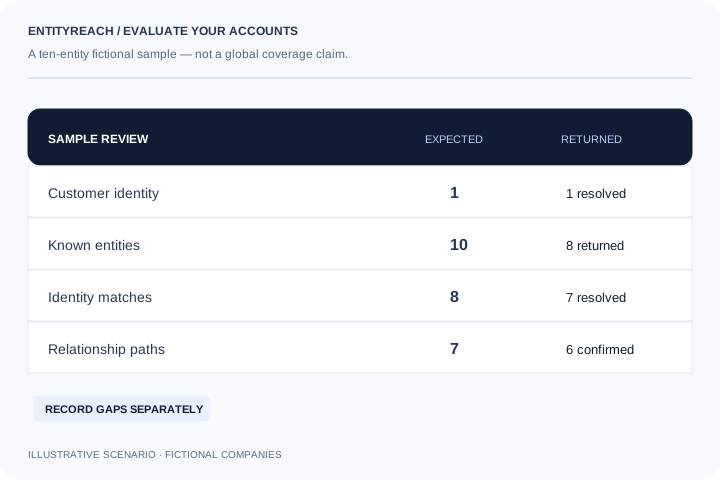
Illustrative sample of ten expected entities: eight returned, seven identity matches resolved and six relationship paths confirmed by the reviewer. These figures are not EntityReach coverage claims.
Build an evaluation your account team can repeat.
Data & coverage: research evidence and account planning decisions
Evaluation question
Evidence to capture
Decision it supports
Did we match the customer?
Legal name, country, registration details and internal reference.
Whether the starting point is suitable for group research.
Which known entities were returned?
Expected, returned and unresolved records in each target market.
Where further coverage checks are needed.
Can we explain the connections?
Relationship paths, source classifications and available dates.
Whether a reviewer can understand the shortlist.
Did the review change an action?
Accepted candidates, exclusions and useful follow-up questions.
Whether the workflow adds value to account planning.
Use cases
Evaluate the questions that matter to you.
Known multinational
Test countries your account owner can verify.
Use a group with familiar subsidiaries in more than one target market. This makes it easier to distinguish matching issues from relationship coverage gaps.
Next actionCompare each expected entity by legal identity and record the result.
Evaluate the accounts your team actually works.
01
Coverage belongs in the result.
Group relationships vary by company and jurisdiction. EntityReach shows the countries and entities returned for your selected company. It distinguishes an unavailable dataset from a successful response with no related companies.
02
Source classification is part of the evidence.
The connected data API can classify group links as modelled and provide the methodology description. Field-level company profile sources may differ from relationship sources. Those distinctions remain visible in the explorer.
03
Retrieved today does not mean filed today.
Retrieval time tells you when EntityReach requested the data. Source-update and event dates are displayed only when supplied. Do not treat a fresh retrieval timestamp as proof that every underlying filing is current.
04
A company match does not guarantee a contact match.
Contact availability varies by company, role and source. Check that a returned person belongs to the intended legal entity and that the title is relevant. Missing email or phone details remain missing; they should not be inferred from a name or domain.
05
Test meaningful coverage, not headline totals.
Before adopting EntityReach across your team, evaluate several complex customer groups. Include the jurisdictions where you need to expand, confirm known subsidiaries and examine missing entities.
Confirm the selected legal entity
Compare known relationships with the returned tree
Inspect modelled and source-attributed links
Review companies with unresolved profile IDs
Establish whether coverage supports your actual account decisions
Choose a sample of known customer groups and relevant countries. Compare expected legal entities with returned records, inspect relationship paths and record gaps. Review source availability separately from whether an entity fits your commercial plan.
Does EntityReach guarantee complete global company coverage?
No. Company details and group relationships vary by jurisdiction, source and record availability. Test the markets and account types you need rather than assuming every company or relationship will be present.
What is the difference between matching and relationship coverage?
Matching asks whether the starting company is the correct legal entity. Relationship coverage asks which connected entities and paths are available. A successful name match does not prove that the group structure is complete.
Why might a known subsidiary be missing?
Possible reasons include an identity mismatch, a missing or unresolved relationship, source coverage or a bounded result. Record the expected company’s legal details and investigate the gap instead of treating absence as proof of independence.
How current is the company information?
Source refresh intervals vary. Retrieval time shows when the data was requested, while source-update or event dates may differ or be absent. Inspect the returned fields and dates for the records relevant to your decision.
Can I evaluate coverage before a wider rollout?
Use a known-account sample to assess matching, group relationships and practical account relevance. The example workflow and downloadable worksheets help structure the review; contact the team to discuss your sample and access requirements.
What should a coverage evaluation worksheet include?
Record the legal entity, country, registration information, expected relationship, returned result, provenance, unresolved issue and reviewer decision. Keep commercial fit and agreement coverage in separate fields.
Should I judge coverage by the number of returned companies?
No. Large groups can include holdings, dormant records, excluded territories or unrelated business lines. Measure the identities and relationships you need and whether the account owner can use them to make a better next decision.
Are business contacts available for every company?
No. A resolvable company profile and service entitlement are needed, and contact fields are returned only when available. Evaluate contact availability separately from corporate relationship coverage.
How should we measure a successful pilot?
Agree your own acceptance criteria for identity matching, relationship evidence and useful account-owner actions. Track gaps, accepted candidates and resulting conversations independently; illustrative figures on this page are not service-level guarantees.
Explore your customer’s wider group.
Start with a company you serve. Find where your offer could fit next.
 View full-size diagram