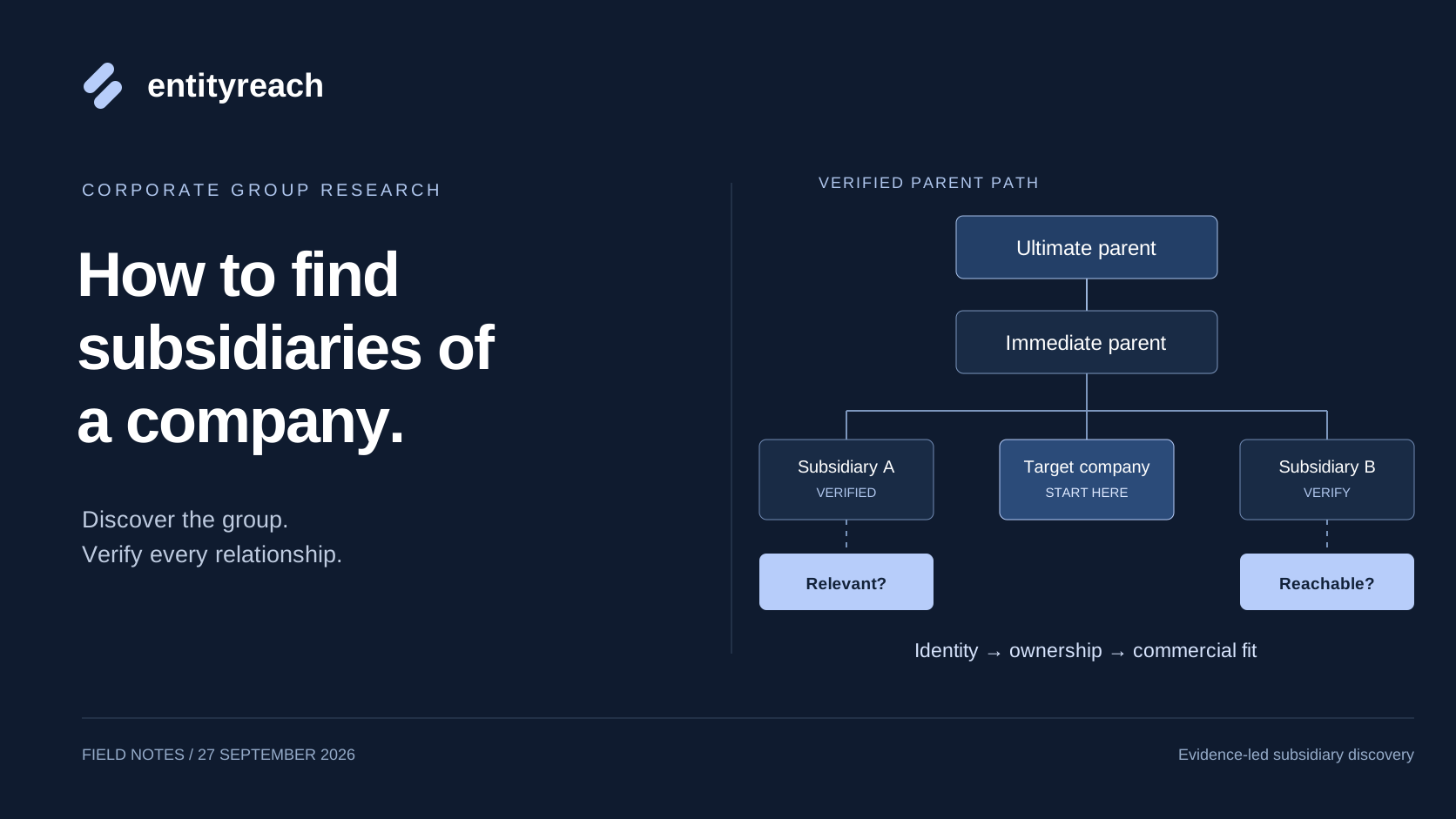
To find subsidiaries of a company reliably, identify the exact legal entity first, trace its ownership chain to the relevant parent, then search downward for controlled entities and verify every parent-child relationship with dated evidence. Only after that should the sales team decide which companies belong in the account plan.
A search for subsidiaries looks simple until the first real corporate group appears. A website may show brands rather than legal companies. Several subsidiaries may use the same domain. An operating company may sit below two intermediate holdings. A recent acquisition may be announced but not completed. A local entity may be legally controlled by the group while buying independently.
The practical problem is therefore larger than producing a list. Enterprise account teams need a defensible answer to three separate questions: which companies exist, how they are related, and which of them are relevant to a commercial decision. Combining those questions into one automated lookup creates false certainty. Keeping them separate produces a smaller, more useful account map.
This guide is about the discovery method. For the terminology behind different parent levels, use the ultimate parent and immediate parent guide. For matching verified entities to CRM records, use the CRM account-matching guide. The steps below connect those disciplines without repeating them.
The short answer: resolve, trace, verify, qualify
Begin with the company already known to you: a customer, prospect, supplier or named account. Resolve it to a legal name, registration identifier and jurisdiction. Next identify its immediate parent and continue upward until the parent that defines the relevant group has been established. Search downward from that parent for direct and indirect subsidiaries. Treat every discovered name as a candidate until its identity and ownership link are verified.
Then introduce a commercial filter. A legally related company is not automatically a sales opportunity. It may be a holding vehicle, a dormant entity, a business outside your product scope or a subsidiary already covered by a group agreement. The account team must establish operating relevance, current coverage, buying autonomy, a plausible problem and a responsible next action.
The order matters. If commercial assumptions are applied before identity is resolved, a brand can be mistaken for a company. If relationship data is accepted without evidence, an old ownership link can distort account coverage. If every verified subsidiary is pushed straight into the CRM, the research creates noise instead of a focused expansion plan.
Subsidiary discovery is a chain of separate decisions
- 01Resolve the targetRequired
Legal name, identifier and jurisdiction
- 02Trace upwardRequired
Immediate parent and ultimate parent
- 03Search downwardDiscover
Direct and indirect controlled entities
- 04Verify each edgeVerify
Dated evidence for every parent-child link
- 05Apply commercial scopeQualify
Relevance, coverage and next research action
Discover broadly, verify narrowly and qualify commercially. Do not ask one source or one score to make all three decisions.
What a subsidiary company is—and what it is not
A subsidiary company is a separate legal entity controlled by another company. The controlling company is its parent. A direct subsidiary sits immediately below that parent; an indirect subsidiary is controlled through one or more intermediate companies. A wholly owned subsidiary is entirely owned within the parent chain. The exact legal test and disclosure available depend on the jurisdiction and the context in which control is reported.
A branch is generally different. It is usually an establishment of the same legal entity rather than a separate company. A brand can be different again: it may be used by one company, shared across several entities or licensed to an unrelated operator. A division is an internal organisational unit. An affiliate is a broad term whose meaning changes between sources. None of these labels should be converted into a subsidiary relationship without checking what the source actually describes.
This distinction affects real sales work. A subsidiary may have its own contracts, directors, employees, data-controller responsibilities and purchasing process. A branch may be part of the entity already covered by an agreement. A brand may help a seller recognise an operating business, but it may not identify the company that can buy. Good group research keeps the customer-facing name while attaching it to the correct legal entity.
It is also possible for a subsidiary to be a parent. A multinational group may contain regional holdings, country parents and operating subsidiaries across several levels. A flat company list loses that structure. Record each parent-child relationship as a separate edge so the team can see whether an entity is directly owned, indirectly owned or merely connected elsewhere in the group.
Anchor the search to one verified legal entity
The first failure point is often the starting record. A salesperson enters a familiar company name, but the name refers to a brand used in several countries. A domain search returns the headquarters while the current contract belongs to a local subsidiary. A shortened name matches several unrelated companies. Expanding from the wrong anchor produces a polished map of the wrong group.
Confirm the legal name, registration number and issuing jurisdiction together. Record the entity status and the date on which it was observed. Where available, add the registered address and recognised aliases. Do not treat a VAT number, stock ticker, internal customer code or tax identifier as interchangeable with the local company-registration identifier. Each identifier has a scheme and scope.
Use the contracting document or customer master as a clue, not as unquestioned truth. Agreements can contain trading names, former names or group-level descriptions. Resolve the named party against current official records. If the legal entity cannot be established, stop the downward search and mark the case for review. More group data cannot repair an ambiguous starting point.
When several entities are commercially relevant, choose one research anchor for each agreement or operating relationship. They can later be joined under the same commercial group. This preserves local reality while allowing a global view. It also prevents revenue attached to one subsidiary from being silently attributed to every company that shares the brand.
How to find subsidiaries of a company step by step
Once the target entity is resolved, inspect its official record and dated filings for ownership information. Identify the immediate parent when disclosed, then continue upward through each intermediate company. The relevant stopping point may be the global ultimate parent, a domestic ultimate or another parent that defines the commercial account. State which definition you used instead of storing a generic parent field.
With the parent established, search downward. Review controlled undertakings, consolidated accounts, official ownership records and other corporate disclosures. Search identified intermediate parents as well as the ultimate parent: a subsidiary list disclosed by a regional holding may be more specific than a global summary. Capture legal names, identifiers, jurisdictions and the path that connects each candidate to the parent.
Use corporate websites, investor materials and press announcements to discover names that may not yet appear in the primary path. These sources are useful for understanding operating brands, geography and business lines. They are not substitutes for legal-entity resolution. A list of “our companies” may mix brands, divisions, joint ventures and selected subsidiaries. Resolve each name separately.
Search sideways only after the upward path is clear. A sister company shares a relevant parent with the target but is not owned by the target itself. That distinction prevents the team from describing every related entity as “your subsidiary” when speaking to a customer. It also shows why the immediate parent can matter: two entities may share the same ultimate parent while belonging to different operational subgroups.
Do not force completeness where disclosure is limited. A verified partial map with explicit unknowns is more valuable than a long list assembled from similar names and common domains. Record why a candidate remains unresolved and what evidence would be needed to decide. This turns a gap into a research task rather than a hidden assumption.
Verify every subsidiary and every ownership edge
A candidate company needs two proofs. First, prove its identity: which legal entity does the name represent? Second, prove the relationship: what evidence connects that entity to the parent, and for what period? Keeping these proofs separate prevents a correct entity match from lending false credibility to an outdated parent link.
Prefer records that identify the companies and relationship directly. Preserve the source, observation date, filing period and wording used. A consolidated annual report may list controlled undertakings according to accounting definitions. A registry record may show legal shareholders under local disclosure rules. A transaction filing may describe an intended acquisition. These can all be useful while answering different questions.
Dates require discipline. The date a transaction was announced, the date it completed, the effective date in a legal filing and the date a data provider collected the record may not be the same. Do not label an entity as a current subsidiary merely because an announcement exists. Conversely, do not assume a registry record describes the commercial arrangement that applies after a divestment.
For each edge, store the immediate parent, child entity, relationship type, evidence and relevant date. If two sources disagree, retain the conflict and route it for review. The newest source is not automatically the best one: it may report a different definition or period. An explainable disagreement is safer than an unexplained overwrite.
Use each source for the decision it can support
| Source | Useful for | Role | Control |
|---|---|---|---|
| Official registry record | Identity, status and filed ownership where disclosed | Primary evidence | Check jurisdiction and observation date |
| Filed accounts or annual report | Controlled undertakings and consolidation scope | Primary or corroborating | Definitions and reporting period matter |
| Regulatory or transaction filing | Announced or completed structural change | Event evidence | Announcement is not always completion |
| Corporate website | Brands, operations and selected group companies | Discovery only | Resolve every name to a legal entity |
| CRM or sales note | Commercial knowledge and existing relationships | Commercial evidence | Not proof of legal ownership |
Entity resolution tools and graph analytics can speed up candidate generation, matching and network exploration. They do not remove the need to define the relationship. A shared address may connect companies without proving control. Similar names may signal a group link or pure coincidence. Require evidence for consequential edges and keep inferred connections visibly different from verified ownership.
Separate the legal corporate group from the sales account
The legal group is a factual model of entities and relationships. The sales account is a commercial model used to coordinate ownership, coverage and opportunities. The two should connect, but they do not need to contain the same set of companies. A group can include holding vehicles, inactive entities and businesses irrelevant to the seller’s territory or product.
Define an inclusion rule for the account map. For example: active operating entities in selected markets that could use the product and are not already covered by the existing agreement. Record excluded entities and the reason. Without an explicit rule, every new holding company inflates the denominator and makes account penetration look worse even though the commercial opportunity did not change.
Keep legal ownership separate from contract coverage. A parent may negotiate a framework while each subsidiary signs locally. Another group may have one agreement that covers named affiliates. A newly acquired company may remain outside the agreement. Ownership data can identify the question, but only contract evidence and customer confirmation can answer it.
Keep account ownership separate too. A global account director may coordinate the group while local sellers own particular entities. The CRM should allow a legal entity to retain its opportunities and history while rolling up to a commercial account view. Merging subsidiary records into the parent to simplify reporting destroys the boundaries needed for accurate expansion work.
Turn verified subsidiaries into qualified expansion candidates
After verification, filter each subsidiary through a consistent commercial test. Is it active? Does it operate in a market and segment you serve? Is the use case plausible? Is the entity already covered? Does purchasing happen locally, regionally or centrally? Is there a relevant relationship path? What fact must be learned next?
Use states that reflect knowledge rather than optimism. A practical sequence is discovered, identity resolved, relationship verified, commercially relevant and qualified for account planning. Add covered, excluded and unresolved states. Do not create an opportunity until the team has evidence of a problem, a responsible buyer or another qualification condition defined by your sales process.
Prioritisation should be explainable. A large subsidiary may be strategically important but unreachable. A smaller sister company may have a clear use case, local authority and an introduction route. Score dimensions separately—fit, current coverage, buying autonomy, evidence quality and relationship strength—so a single composite number does not conceal the reason a company was ranked.
A group list is not an expansion pipeline
The narrowing process protects seller attention. A corporate group with 40 discovered names may yield 20 verified entities, nine relevant operating companies and four candidates worth adding to the plan. The exact numbers will differ by account. The principle is stable: database coverage measures discovery, not pipeline, and legal proximity does not measure buying intent.
For stakeholder work, move from the verified company map to the relationship-mapping method. Confirm who owns the problem, who controls the relevant decision and whether the existing customer relationship can support an introduction. A parent connection explains why the company belongs to the group; it does not grant permission to approach its employees as an extension of the current customer.
Monitor structural changes without rewriting account history
Corporate structures change through acquisitions, divestments, new incorporations, mergers, dissolutions and internal reorganisations. Monitoring should identify the event, preserve the earlier structure and route the change to a business decision. A notification with no owner or decision path becomes another inbox rather than a maintained account map.
Define which entities matter enough to monitor and which events require review. For an active strategic account, a parent change may trigger checks on account ownership, contract coverage, territory, open opportunities and stakeholder roles. A new subsidiary may become a research candidate. A dissolution may require CRM status updates while preserving historical transactions attached to the old entity.
Store valid-from, valid-to or observation dates where the evidence supports them. Keep the previous edge rather than deleting it. This allows the team to explain why an account plan, territory decision or opportunity roll-up looked different six months earlier. It also prevents current hierarchy data from silently changing historical revenue reports.
Route structural changes to a defined business decision
Add as a research candidate; do not create pipeline automatically
Track the event and expected scope; wait for completion evidence
Recheck account ownership, contracts and commercial coverage
Preserve history and update the current entity status separately
Do not let monitoring automate legal or commercial conclusions that require review. An acquisition announcement can justify a task, not an immediate account transfer. A new parent link can justify checking a contract, not assuming coverage. Design the workflow so automated detection creates a bounded investigation and a named person records the outcome.
Common ways subsidiary research fails
Starting from a brand or website
A familiar trading name feels precise but may represent several legal entities. Resolve the entity before expanding the group. Shared domains should generate candidates, not merges or ownership claims.
Using one parent field for every decision
Immediate parent, domestic ultimate and global ultimate answer different questions. Store the relationship path and choose the parent definition appropriate to the task. Flattening the hierarchy hides intermediate companies that may control regional operations.
Confusing discovery with verification
A website, news item or similarity signal can reveal a company name. It does not necessarily establish current control. Preserve discovery sources, then require appropriate evidence before the edge is activated in a governed hierarchy.
Counting every entity as white space
Holding companies, dissolved entities and already covered subsidiaries can inflate the opportunity. Define the relevant population before measuring penetration. Unknown coverage is not the same as uncovered.
Equating ownership with purchasing authority
A parent may set policy while subsidiaries buy locally, or a shared procurement function may cover several entities. Verify the buying model. Never infer that a customer contact can sponsor an introduction across the group solely because the companies share ownership.
Replacing history with the latest structure
Overwriting an old parent link makes earlier plans and reports difficult to explain. Preserve dated relationships and decide whether a report uses the current hierarchy or the hierarchy valid at the reporting date.
A subsidiary research checklist for enterprise account teams
- Define the decision. State whether the work supports account scoping, coverage review, territory assignment, compliance or another purpose.
- Resolve the anchor. Confirm legal name, identifier, jurisdiction, status and observation date.
- Trace the upward chain. Record each immediate parent until the relevant ultimate or account parent is reached.
- Search downward and sideways. Generate candidate subsidiaries and sister companies from the verified parent path.
- Resolve every candidate. Distinguish legal entities from brands, branches, divisions and duplicate names.
- Verify every edge. Preserve evidence, dates, definitions and unresolved conflicts.
- Apply the commercial scope. Include relevant operating entities and record exclusions with reasons.
- Check coverage and authority. Verify contracts, existing deployments, buying autonomy and account ownership separately.
- Qualify the next action. Add only companies with a useful research question, relationship route or validated problem to the active plan.
- Monitor consequential changes. Route events to named reviewers and preserve the previous hierarchy.
Evaluate data providers with difficult cases from your real target market: shared domains, cross-border parents, intermediate holdings, recent acquisitions, renamed entities and limited private-company disclosure. Compare how well each provider resolves identity, explains relationships, dates its evidence and represents unknowns. A larger returned list is not automatically the more accurate or commercially useful result.
The final output should be understandable without the researcher present. A reviewer should see the legal entity, ownership path, evidence, relevant date, commercial state and next action. Unknowns should remain visible. That is what turns subsidiary data into an accountable enterprise workflow instead of another static company list.
Find the legal group first. Build the sales account second. Treat the difference as a control, not an inconvenience.
From there, use the broader account expansion strategy to rank the verified candidates, test white space and agree a 30-day action plan. The hierarchy establishes where to look. Qualification determines where the team should spend time.
Frequently asked questions
What is a subsidiary company?
A subsidiary company is a separate legal entity controlled by another company, commonly called its parent. Control may arise through voting rights, ownership or another legally recognised mechanism, depending on the jurisdiction and reporting context. Because the subsidiary remains a distinct entity, its contracts, identifiers, filings and operating status should not be replaced with those of its parent.
What are subsidiaries of a company?
They are legal entities that the company controls directly or indirectly. A direct subsidiary sits immediately below the company in the ownership chain. An indirect subsidiary is controlled through one or more intermediate entities. A complete group view can therefore contain several levels, and a company may be both a subsidiary of one parent and a parent of other subsidiaries.
How do you find subsidiaries of a company?
Identify the exact target entity, confirm its registration number and jurisdiction, then trace its immediate and ultimate parents. Search downward from the relevant parent using official registry records, filed accounts and other dated corporate disclosures. Verify each candidate separately. Do not treat shared websites, addresses or brand names as proof that two companies have a parent-subsidiary relationship.
How can you find subsidiaries of a private company?
Start with the private company’s registry record and statutory filings, then inspect disclosed shareholders, controlled undertakings and consolidated accounts where available. Search the records of identified parent and intermediate companies as well. Private-company disclosure varies by country, so the correct output may be a verified partial group with explicit gaps rather than an apparently complete list built from weak signals.
What is a wholly owned subsidiary company?
A wholly owned subsidiary is a separate company whose ownership is held entirely by its parent, directly or through the ownership chain. The exact evidence needed to support that description depends on the available filing and jurisdiction. Wholly owned does not mean operationally identical: the subsidiary can still have its own directors, contracts, obligations, systems and local buying process.
Is a subsidiary a separate company from its parent?
Usually, yes. A subsidiary is normally a distinct legal entity, while a branch is generally an establishment of the same legal entity. That distinction matters in account planning because the subsidiary may sign its own agreement, employ its own staff or run a local procurement process. Always confirm the entity type in the relevant jurisdiction instead of relying on the trading name.
What is the difference between a subsidiary and a branch?
A subsidiary is ordinarily a separate legal entity controlled by a parent. A branch is generally part of the same legal entity operating at another location. Registry terminology and identifiers differ across countries, so verify the local definition. In a CRM, branches may need location records, while subsidiaries usually need distinct legal-entity records linked into the corporate hierarchy.
What is the difference between a subsidiary and an affiliate?
Subsidiary describes a control relationship. Affiliate is broader and can refer to entities connected through common ownership, significant influence or another business relationship, depending on the source. Because the term is used inconsistently, record the precise relationship rather than storing affiliate as an unexplained label. Sales teams should never infer shared purchasing authority from affiliation alone.
How do you find the parent company of a subsidiary?
Resolve the subsidiary to its legal name, registration number and jurisdiction, then inspect official ownership records and dated filings for its direct shareholder or immediate parent. Continue upward until the relevant ultimate parent is reached, documenting each link. Do not jump from a brand website to a global parent without preserving the intermediate entities that explain the actual control chain.
Can a subsidiary company have its own subsidiaries?
Yes. A subsidiary can control other companies and act as an intermediate parent within a larger group. This is common in multinational structures organised by geography, product line or acquisition history. A flat list hides these levels. Store each parent-child edge separately so the account team can distinguish direct subsidiaries from deeper entities and choose the correct commercial scope.
Why is a company website not a complete list of subsidiaries?
Corporate websites are designed for customers, investors or recruitment, not as authoritative legal-entity inventories. They may show brands, selected operating businesses or recent acquisitions while omitting dormant companies, holding entities and local subsidiaries. Use the website as a discovery source, then resolve every name against official records and dated filings before adding it to a verified corporate group.
How often should subsidiary information be updated?
Review important groups when a transaction, filing, name change, dissolution or internal account event suggests the structure may have changed. For active strategic accounts, monitor consequential entities continuously and apply a defined review cadence to the rest. Keep observation dates and previous relationships so a new parent link does not silently rewrite the historical account context.